Comments
The Avengers began to come into their own in the 1970s, continuing to develop their rogues’ gallery both with earth-level threats and super teams that pushed them to the limit. This decade saw them head into the cosmos and get in the middle of a war between two worlds and also fight time travelers, criminal bank robbers, and killer robots, all intent on destroying Earth’s Mightiest Heroes. The Kree-Skrull War, the Korvac Saga, and Thanos all showed that the team was more than just about fighting Earth’s greatest villains, as they had to step up to become the planet’s protector against threats from the stars and beyond.
From morally conflicted villains who want to save humanity at all costs to mind-controlled heroes based on alternate world villains, here is a look at the most iconic Avengers villains of the 1970s, ranked by their importance to the team.
10) The Lethal Legion
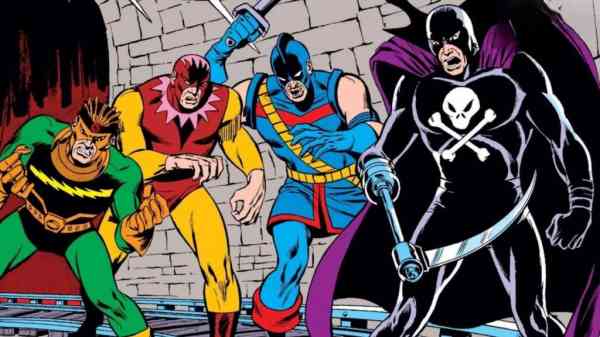
The Grim Reaper became a major Avengers villain in the 1960s when he blamed the team for the death of his brother, Wonder Man. Even when Wonder Man came back to life, the Grim Reaper didn’t change his stripes and became a villain to both the Avengers and his own brother. To achieve this goal, he created his own supervillain team known as the Lethal Legion. The team itself first appeared in The Avengers #78-79 (1970) by Roy Thomas and Sal Buscema.
The original lineup was assembled by the Grim Reaper and included Man-Ape (M’Baku), Power Man (Erik Josten), the Living Laser, and the Swordsman. The entire reason for their existence was to gain revenge for the death of Wonder Man, but then they became more straightforward villains after that. The second version of the Lethal Legion was formed in 1977 by Count Nefaria and included Living Laser, Power Man, and Whirlwind. However, that ended when Nefaria betrayed the team.
9) Kree / Skrull
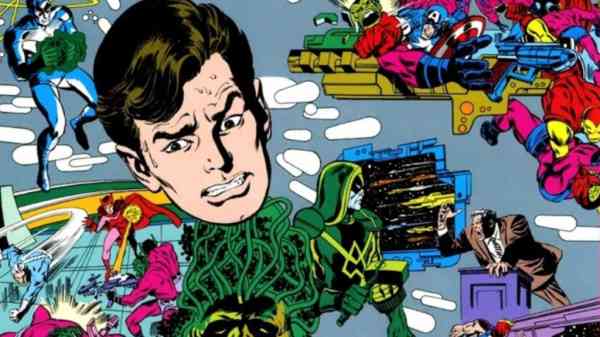
The Skrulls first appeared in the pages of The Fantastic Four, and the Kree took center stage thanks to the original Captain Mar-Vell. However, the Kree-Skrull War was shown to be an eons-long war between the two races, and the main “Kree-Skrull War” event ran in The Avengers #89-97 (1971-1972) by Roy Thomas, Sal Buscema, John Buscema, and Neal Adams. Ronan the Accuser and the Supreme Intelligence led the Kree forces against the Skrull Empire, and Earth was caught in the middle.
This is what brought the Avengers into the battle, and they ended up with enemies on both sides of the war. The entire allegory here was based on real-world conflicts, including McCarthyism, HUAC, and the Arab–Israeli conflict. This led to several big storylines in the future, including “Secret Invasion” in the 2000s and later the “Empyre” event that started an even bigger war, but the conflict all started here.
 Ares
Ares
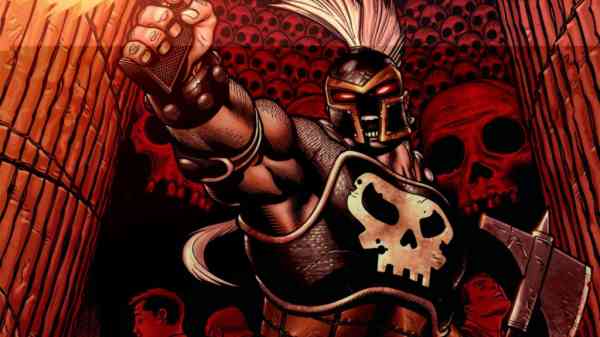
One of the most surprising villains of the 1970s was Ares, the Greek God of War. Ares made his Silver Age debut in Thor #129 (1966), but his time against the Avengers came in a storyline that played out from Avengers #98-100 (1972). This happened after the Avengers returned to Earth following the Kree-Skrull War and then found groups on Earth starting riots, many seeming to be compelled to act violently. As the Avengers tried to find the reason, it all came down to the machinations of Ares.
Ares was working behind the scenes to try to start new conflicts and wars, and this all came to a head when two Olympian warriors attacked Avengers Mansion, with a dark prophecy proclaimed for Hercules. Ares was so powerful in this moment that every member of the Avengers in history had to return to the team in issue #100 to fight together to stop him. No Avengers villain in the 1970s required such a massive roster to defeat him, proving his power levels.
7) Kang the Conqueror
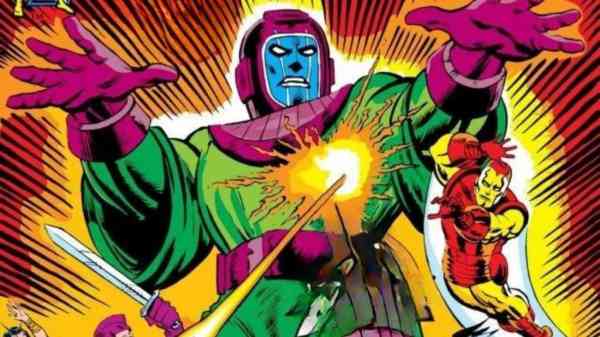
Kang the Conqueror came into prominence again in the 1970s. This happened in the “Celestial Madonna” storyline, where his secrets were revealed. The “Celestial Madonna” had a lot going on, including bringing in Vision and Scarlet Witch and a complicated story involving Swordsman and Mantis. By the time all was said and done, it was proven that this was all masterminded by Kang. The story had Kang trying to figure out who the Celestial Madonna was, with him coming down to either Scarlet Witch, Mantis, or Agatha Harkness.
What really makes this 1970s Avengers storyline so important is that this was where readers learned that Kang, Immortus, and Rama-Tut were all the same person, but from different places in time. This would lead to many moments in the future where the three often plotted against each other while also forming the Council of Kangs at other times. This was also the storyline that was the catalyst for the Kang storyline “Avengers Forever” in the 1990s.
6) The Squadron Supreme

The Squadron Supreme debuted in The Avengers #85-86 (1971) by Roy Thomas and John Buscema. This was a superhero team from Earth-712, and it was clearly copied after the Justice League in DC Comics. The team included Hyperion (Superman), Nighthawk (Batman), Doctor Spectrum (Green Lantern), Power Princess (Wonder Woman), and the Whizzer (the Flash). They are also similar to the Squadron Sinister, who fought the Avengers in comics in 1969.
The Squadron Supreme were not villains, but they fought the Avengers, with each team believing the other was a villain. This later led to the “Serpent Crown Saga,” in Avengers #141-149 (1976) by Steve Englehart and George Perez, where Roxxon’s Hugh Jones uses the mind-controlling Serpent Crown to turn the Squadron against the Avengers. This was also the storyline that brought Hellcat into the Avengers as a new member. Years later, another version of the Squadron Supreme became villains to the Avengers when Agent Coulson and Mephisto changed Earth’s history in “Heroes Reborn.”
5) Graviton
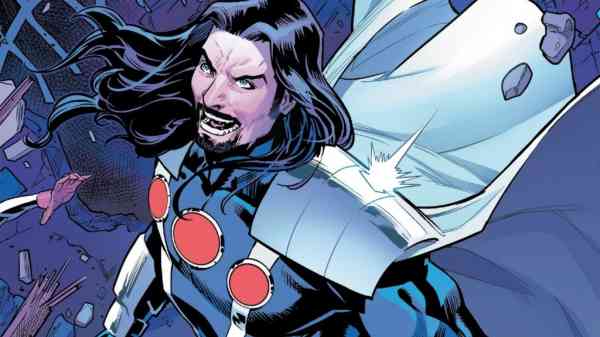
Graviton debuted in The Avengers #158 (1977) by Jim Shooter and Sal Buscema. His real name is Franklin Hall, a Canadian physicist whose experiment in the Canadian Rockies goes wrong. This error flooded him with graviton particles and granted him total control over gravity. While he was a new villain on the scene when he debuted, he was shown to be an A-list villain and was extremely overpowered from the start, proving he was going to cause problems for a very long time.
Graviton seized the research facility, cutting it off from the outside world and forcing the Avengers to respond to a distress signal. When they arrived, he proved he was more than up to the task of taking the fight to the entire team. There are very few Marvel villains who match his raw power. His gravity manipulation lets him crush, levitate, or pin opponents and even lift large structures, making him a perennial Avengers heavyweight bad guy.
4) Count Nefaria
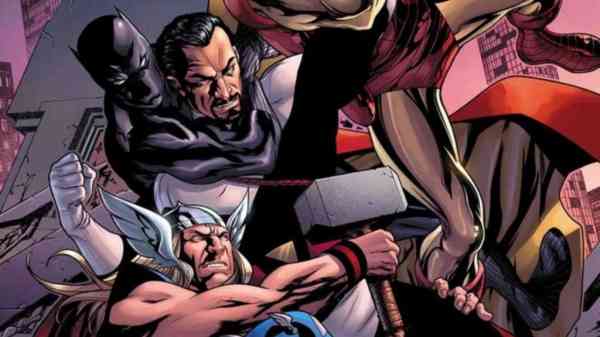
Count Nefaria debuted in Avengers #13 (1964), and while he had no powers there, he was still powerful thanks to his connections and the fact that he was running the Nefaria Crime Family. However, by the 1970s, he was powered up a great deal and proved to be more than equipped to not only match the Avengers in power but also beat them in the right circumstances.
His defining 1970s arc is The Avengers #164-166 (1977) by Jim Shooter and John Byrne, where he went from being a crime lord to an almost god-level threat. Nefaria assembled a new Lethal Legion during the arc and then betrayed them to steal their powers after using Baron Zemo’s ionic-energy treatments to amplify the Legion’s powers. Wonder Man, Iron Man, Thor, and the Vision all had to work together at once just to bring him down. This remains among the greatest superpowered brawls in comic book history.
3) Ultron
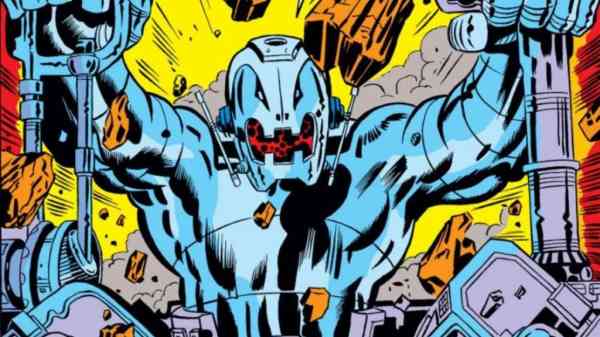
Ultron debuted in 1968, but he really started coming into his own in the 1970s. This was when he began to build his “family.” “The Bride of Ultron” took place in The Avengers #161-162 (1977) by Jim Shooter and George Perez. It was this storyline that saw Ultron 8 build the robot Jocasta using an abducted Janet Van Dyne’s brainwaves, attempting to create a bride for himself to have a loved one like his “father,” Hank Pym.
Jocasta debuted in The Avengers #162, but as Vision did before her, she betrayed Ultron and ended up joining the Avengers. The Avengers finally beat this version of Ultron in Avengers #170-171 (1978) with help from Ms. Marvel, ending the robot villain’s Bronze Age run. He also had a smaller appearance earlier in the decade when he showed up when Maximus rebuilt him as Ultron-7 to disrupt the wedding of Crystal and Quicksilver in Avengers #127 (1974).
2) Michael Korvac
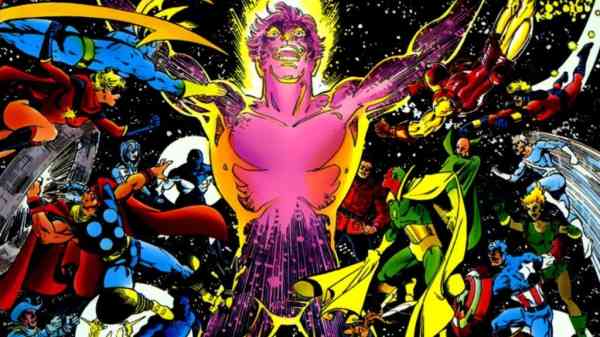
One of the most famous Avengers storylines of all time took place in The Avengers #167-168 and #170-177 (1978) by Jim Shooter, David Michelinie, George Perez, and David Wenzel. This storyline was “The Korvac Saga,” and it featured a new villain named Michael Korvac, a man who first appeared in Giant-Size Defenders #3 (1975). Korvac was a 31st-century computer technician who collaborated with the alien Badoon and was punished by being grafted to a machine.
He then became one of the most powerful beings in existence when he traveled to one of Galactus’s stations and stole the Power Cosmic, remaking himself as a perfect human. What made Korvac stand out was that he didn’t see himself as a villain. His only goal was to make the Earth a utopia and a perfect place, against humanity’s will. The Avengers and Guardians of the Galaxy fought him and lost. He killed them all before reviving them and willing himself to die when he realized he had gone too far. Korvac has returned since then, but this first appearance was a masterful story.
1) Thanos
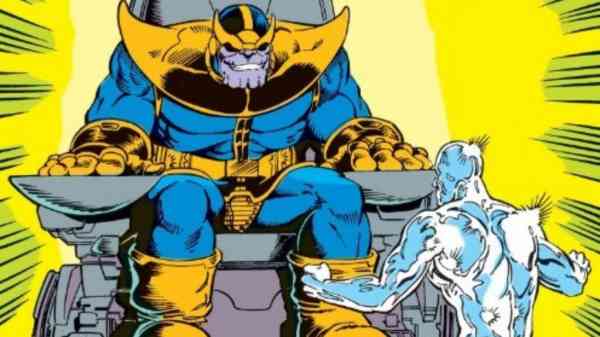
Thanos actually debuted in The Invincible Iron Man #55 (1973) by Jim Starlin and Mike Friedrich. Thanos then became a big part of Starlin’s cosmic Marvel universe before he was finally brought into conflict with the Avengers. His 1970s defining Avengers moment is the two-part epic in Avengers Annual #7 and Marvel Two-In-One Annual #2 (1977), where Thanos amasses power to snuff out every star in the universe. His tool here was the Cosmic Cube.
In the famous climax, the heroes couldn’t beat him until Spider-Man freed the Soul Gem, and the soul of Adam Warlock emerged to turn Thanos to stone, effectively killing him for over a decade. This was, of course, only the start because Thanos ended up getting the Infinity Gauntlet and finally achieved his goal of killing half the universe. It seems almost hard to believe, but this powerful 1970s Avengers villain remained dead until 1990 and the start of the “Infinity Gauntlet” storyline.
What do you think? Leave a comment below and join the conversation now in the Forum!
The 10 Most Powerful Spider-Man Villains, Ranked